Byte # 8: Fading Spirits, Rising Scripts: The GLP-1 Effect on Beverages
📉 Beverages or 💊 Obesity Drugs: Where Should Your Money Go?
Welcome back, Ladies & Gentlemen — Byte #8 is here!
Today, we’re diving into two major sectors and their surprising connection: Consumer Defensive (specifically Beverages – Wineries & Distilleries) vs. Healthcare (GLP-1 Obesity Drug Market). Their performance is more correlated than you might think!
🍷 First up: Beverages – Wineries & Distilleries
Let’s begin by looking at the stock performance of three major alcohol companies over the past year:
BF.A (Brown-Forman): ▼ 36.11%
STZ (Constellation Brands): ▼ 31.80%
DEO (Diageo): ▼ 21.10%
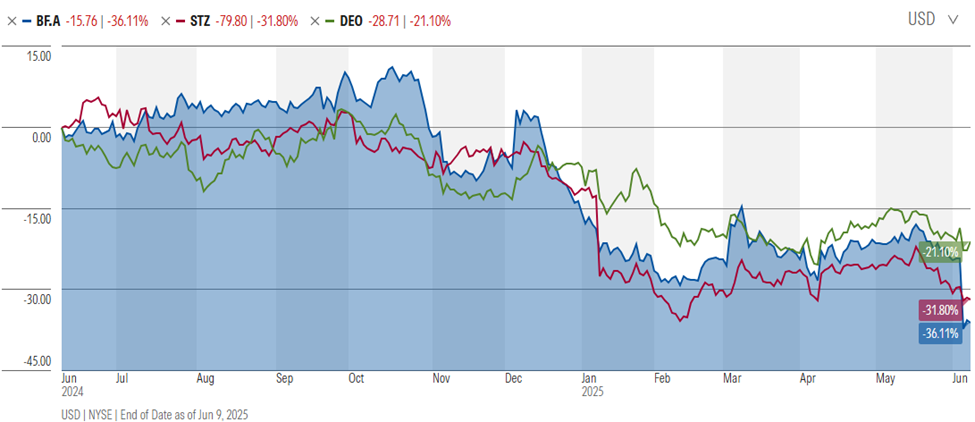
These are meaningful declines — The trend is clearly negative, with no company bucking the broader downtrend in the alcohol sector.
What Does This Indicate?
Sector-Wide Weakness: The consistent decline across all three companies suggests a sector-wide issue, not just problems with a single company.
Potential Causes: This could be due to changing consumer preferences (e.g., shift to non-alcoholic beverages), economic headwinds, regulatory changes, or company-specific challenges.
🔍 Brown-Forman Earnings Call: Sector Headwinds Confirmed
Here’s a key takeaway from Brown-Forman’s Q4 FY2025 earnings call (June 6, 2025):
“The 2025 earnings decline was attributed to a combination of weaker consumer demand, trade destocking, unfavorable currency movements, elevated costs, heightened competition, and global uncertainties.”
When asked about the fiscal 2026 outlook, the CEO shared this:
“While some consumer categories like lodging and leisure are performing well, the spirits sector is facing unique pressures — including soft consumer demand, competition from alternatives like cannabis and GLP-1 drugs, and changing preferences among younger consumers (Gen Z).”
He emphasized that while these factors have led to stock underperformance, he believes they’re cyclical, not structural — driven by tighter consumer wallets and shifting priorities, not necessarily a permanent move away from spirits.
💡 And This Is Where It Gets Interesting…
If you’ve been following the GLP-1 obesity drug market, you’ll notice what’s unfolding: One sector is actively impacting the other.
Consumer shifts toward wellness — partly driven by the uptake of GLP-1 drugs — are influencing alcohol consumption behavior. The impact may still be moderate, but the direction is clear.
📈 Why Consider GLP-1 Stocks?
Global Market Opportunity Projected Total Addressable Market (TAM): $150B–$300B by 2035
Early-Stage Adoption U.S. usage at ~2–3%, global at ~1% — with room to grow significantly
Supply Chain Scaling Manufacturers are rapidly increasing capacity to meet demand
Expanded Use Cases Beyond obesity: promising data for heart disease, sleep apnea, Alzheimer’s, cancer, and more
Policy Tailwinds Public insurance programs are exploring broader reimbursement for these drugs
Innovation Pipeline Oral GLP-1s, less frequent dosing, and higher-efficacy compounds are in development
📊 Performance Snapshot: Top 3 GLP-1 Players namely Novo Nordisk (NVO), Eli Lily (LLY) and Amgen (AMGN)
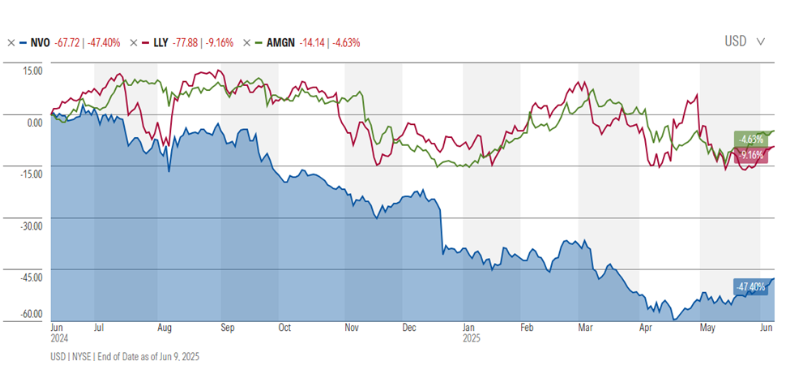
While Novo Nordisk has pulled back recently — due to supply constraints, a CEO transition, and mixed clinical trial results — the company remains a dominant global player:
Controls ~34% of the global diabetes market
Accounts for 50% of insulin therapy and ~50% of the $40B GLP-1 space
Novo is actively responding: ramping up production, cutting prices, launching direct-to-consumer strategies, and investing in oral drug development.
If its upcoming trial results strengthen and prescription trends improve, Novo could regain momentum — and for long-term investors, it may present a value opportunity. As always, do your own diligence.
🧠 Final Take
So — which sector should you favor?
📉 Both Healthcare and Consumer Defensive sectors are down Year-over-Year (YoY), 🔁 But GLP-1 obesity drugs stand out with superior long-term growth potential, while Beverage Alcohol faces mounting headwinds from shifting consumer behavior — including from GLP-1 adoption itself.
That said, should you still want to invest in the Beverage Alcohol space, it's best to wait for confirmation: 👉 Consider waiting for signs of stabilization or reversal (e.g., flattening of the downtrend, positive earnings surprises, or improving sector news).
That’s it for today’s Byte #8! Thanks for reading — and I’d love to hear: which side are you betting on?
