Byte # 66: The AI Build-Out Is Bigger Than You Think
Hello and a huge Welcome to all my subscribers, readers, viewers!
This week’s byte is all about the most talked-about topic in the markets today: The AI Build-Out. I recently came across this PwC Global Data Center Outlook report and it sent me down a rabbit hole. The numbers they share are absolutely mind-boggling.
If you thought recent hyperscaler capital expenditure (capex) commentary was aggressive, this report proves we are still underestimating just how massive this infrastructure cycle will be.
The 7 Core Takeaways for Everyday Investors
A multi-decade mega-cycle, not a one-time build: AI infrastructure is not a short-term trend that will fade in a few quarters. PwC’s base case projects a staggering $31.6 trillion in cumulative global data center spend through 2050.
Annual spending is accelerating, creating a permanent upgrade loop: Data center capex isn't flattening out once the initial buildings are up. Annual spending is projected to climb from roughly $800 billion today to nearly $1.8 trillion by 2050 driven by continuous chip refresh cycles and hyper-dense compute demands.
The US is the ultimate asset-gathering powerhouse: While growth is global, the US is positioned to capture nearly half of all global spend. Unmatched chip ecosystem depth, hyperscaler concentration, and massive policy alignment give the US an outsized share, followed by China, India, Europe, and the Middle East.
The real money is in the "brains," not the bricks: The physical building shell is the cheap part. High-velocity spending on GPUs, servers, networking gear, and accelerators completely dominates the capex stack. PwC expects rapid hardware refresh cycles to swallow the majority of spend as older equipment is continuously swapped out for more powerful generations.
The upside potential is astronomically high: If global AI adoption accelerates faster than expected, PwC's aggressive upside scenario shows total cumulative spend could approach a massive $50 trillion - a number that makes today's historic hyperscaler budgets look highly conservative.
Even the downside scenario implies enormous spending: Even under highly cautious, "slow AI" adoption assumptions, PwC still forecasts ~$22 trillion in cumulative spend. This highlights how significant the underlying demand for data center infrastructure could remain even if AI adoption falls short of expectations.
Power infrastructure has a massive lead-time problem: Back in May, I broke down the massive structural constraints facing our energy landscape in Byte # 52 (Demand is Surging, Grid Isn't Ready) and Byte # 53 (AI Energy Bottleneck: Electricity is the New Oil). PwC's report confirms that this physical supply chain crunch is worsening. Critical equipment like transmission gear, substations, and large transformers now carry multi-year waitlists. The data centers that actually break ground on time will be the ones executing "pre-procurement" strategies to buy this hardware years in advance, making aggressive supply chain management a primary competitive advantage.
Low-carbon power capacity is the ultimate location scout: Data center builders can no longer just put up a building and figure out the electricity later. The long-term winners will be regional markets that scale clean energy alongside data center construction from day one. Regions that can deliver reliable, low-carbon power at scale like the Nordics, Chile, and Canada will turn energy from a structural constraint into a massive economic advantage.
⚠️ The Power Trap: Watch Out for Regulated Utility Stocks
While electricity is the ultimate bottleneck, retail investors need to tread carefully before blinding loading up on traditional utility stocks. Modernizing the power grid to handle these massive AI electrical loads will require immense, upfront capital expenditures (capex) from utility companies.
Because electric utilities are heavily regulated by state governments, their allowed return on equity (ROE) is strictly capped. Do not expect explosive, tech-like returns here. Due to their massive capex burdens and capped profit margins, traditional utilities will function more like defensive dividend plays than high-flying growth engines.
To capture the true upside of the power crisis, another approach is to explore free-market energy companies and the businesses supplying the critical hardware needed to expand the grid.
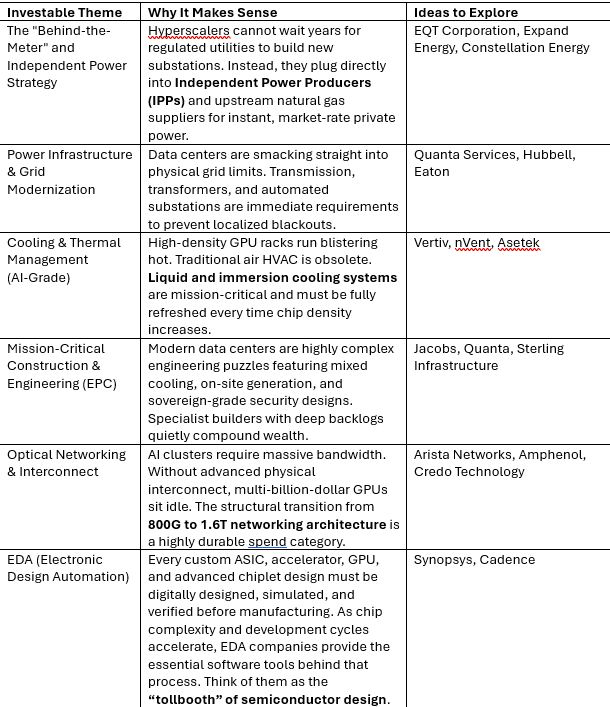
AI Infrastructure Build‑Out: 6 Investable Themes
These opportunities span different layers of the AI infrastructure stack from the power and physical infrastructure needed to run AI, all the way upstream to the software used to design the increasingly complex chips that power it.
However, a quick heads-up: These are not buy or sell recommendations. Think of them as the key themes and structural stock ideas worth exploring across the broader AI infrastructure value chain.
The Byte’s closing thought
PwC’s report ends with a line that sums up the entire opportunity:
“The data center is essentially a chip‑replacement subscription with a building wrapped around it.”
The AI boom isn't just a story about chips. It's a story about everything required to make those chips useful.
Power. Cooling. Grid infrastructure. Networking. Construction. Semiconductor design.
And that brings us back to the question I want you to keep in mind whenever you hear about the next big AI investment:
Where is the money actually going…and who is capturing it?
Thank you again for being an indispensable part of my investing journey, and I shall see you next week!
Have a wonderful week ahead…
Your friend in investing,
Pooja
