Byte # 61: Markets Are Volatile. These 10 Questions Keep Me Grounded.
Dear Readers,
I wrote this last year in Oct’25. I think it's even more relevant today than when I first published it.
With markets swinging wildly over the past few weeks, it's easy to become consumed by stock prices.
We refresh our portfolios. We watch the headlines. We wonder whether we should buy more, sell, or simply wait.
But here's the question I've been asking myself:
Has anything about the business changed or only the stock price?
That's an important distinction.
Given the volatility and uncertainty, we're experiencing as investors, I often find myself revisiting these ten questions. They help me focus on the business rather than the daily market noise.
If you've read this before, consider it a timely reminder.
If you're new here, I hope it becomes a framework you'll use for years.
1. Do I Understand the Business?
Can I explain what the company does and how it makes money clearly in under 3 minutes? If not, there’s more digging to do.
2. How Has Financial Performance Trended?
Check revenue, earnings, and margins over the past 5–10 years. Are profits growing or shrinking compared to peers?
Tip: I use the free resource StockAnalysis.com to review these financial metrics.
3. Does It Have a Durable Moat?
What protects its market position…technology, brand, scale, or cost efficiency?
If you want to understand moats in more detail, check out Byte #9, where I explain this concept in depth.
4. Are Industry Trends Helping or Hindering Growth?
Is the company operating in an industry with strong tailwinds that boost its prospects—like AI infrastructure, energy, or defense? Or are there headwinds, such as regulatory challenges or shifting consumer preferences, that could slow growth?
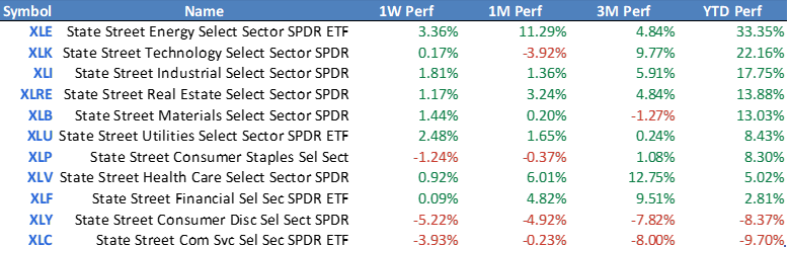
Check out the table below showing how different sectors have performed year-to-date and over shorter time frames. Energy has clearly been one of the strongest-performing sectors across all periods.
Also, notice how sector leadership can change quickly. Over the past month and week, several sectors have outperformed Technology (XLK). I use this chart as a quick way to get a broader view of where strength and weakness are showing up across the market.
5. What About Free Cash Flow and Capital Allocation?
Strong free cash flow is a green flag.
How is it being used in - R&D, acquisitions, dividends, or buybacks used?
I also look for Return on Invested Capital (ROIC) above 12–13% as a sign of efficiency.
6. Is Financial Health Solid?
Check the balance sheet strength, including debt levels and leverage ratios, to ensure the company isn’t overburdened by debt.
It answers a simple question:
If the company used all of its free cash flow to repay debt, how many years would it take?
For example, a Debt/FCF ratio of 5 means it would take approximately 5 years of current free cash flow to eliminate all outstanding debt.
That's generally my ceiling. If the ratio is above 5, I usually filter the company out.
Again, you can find this metric under the Statistics section of StockAnalysis.com.
7. How Competent Is Management?
Capital allocation, strategic execution, and insider buying activity matter far more than promises made on earnings calls.
A strong management team consistently delivers results and allocates capital wisely to drive long-term value.
Don’t overlook the Management Discussion & Analysis (MD&A) section in annual reports. It offers valuable insights into how management views past performance and future strategies.
You can learn more about analyzing MD&A in my Byte # 21.
8. What’s the Growth Potential Given Its Size?
Large companies typically grow more slowly but can still create significant value over time.
Smaller companies may grow faster but tend to carry higher risk.
For example, Tesla, which currently has a market cap of $1.2 trillion – can it reach $2.4 trillion in the next few years, effectively doubling its stock price.
Ask yourself: do you think that’s realistic? It’s important to understand the growth potential and risks before investing.
9. Why Am I Investing?
Growth?
Income?
Speculation?
The company should fit both your financial goal and risk profile.
10. What’s My Time Horizon?
Patience compounds return.
Long-term investing rewards consistency over excitement.
We are investing not for today or tomorrow, but for years down the road so we can benefit from the power of compounding.
The goal isn’t to predict the next big winner.
It’s to understand why you’re investing and what you’re willing to hold through the noise.
That’s what Invest Smart with Pooja is all about…learning, questioning, and improving, one thoughtful step at a time.
So, the next time you analyze a company, ask yourself:
Why do I want to own a piece of this business?
And can this business help me achieve my long-term financial goals?
Thank you for being part of this journey with me.
If you find value in these weekly insights, please subscribe and continue growing alongside me - one Byte, one lesson, and one smarter investment decision at a time.
Make every day - and every investment - meaningful.
Cheers
Pooja
