Byte # 44: In a market obsessed with AI, two ‘boring’ funds quietly beat the S&P
Hello Friends,
Welcome to this week’s Byte.
Most market conversations today revolve around mega-cap tech, AI, and momentum names. But when I zoom out on some of my own portfolio experiments, a quieter story emerges.
Sometimes the most “boring” parts of a portfolio are the ones doing the real work when volatility rises.
The charts below compare three positions:
FSUTX – Fidelity Select Utilities fund
NLR – VanEck Uranium and Nuclear ETF
IVV – iShares Core S&P 500 ETF (S&P 500 proxy)
Chart 1 – 2026 YTD
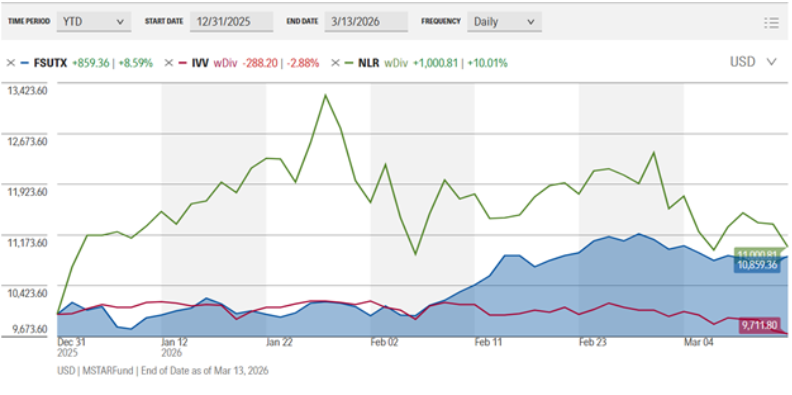
While the S&P proxy (IVV) is down ~3% this year, both FSUTX and NLR are up roughly 8–10%.
In a market where growth stocks have been choppy, these funds have quietly acted as portfolio ballast.
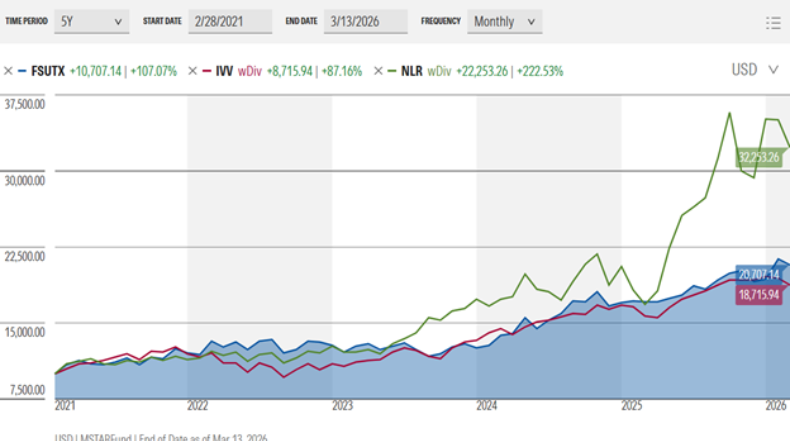
Chart 2 – 2021 to March 26
Over the last five years, both funds have materially outperformed the S&P 500 proxy.
IVV: +87%
FSUTX: +107%
NLR: +225%
FSUTX compounded steadily with much smaller drawdowns.
NLR, on the other hand, stayed relatively quiet for years — then broke away sharply starting in late 2023 and accelerated after mid-2025.
Two very different paths to strong returns.
When Policy Meets Theme
The inflection point for NLR wasn’t random.
On May 23, 2025, President Trump signed an executive order aimed at boosting and modernizing the U.S. nuclear energy sector.
Nuclear energy suddenly moved from “interesting theme” to policy-backed priority. Capital followed, and the ETF started reflecting that shift.
How I Actually Positioned It
I had written about nuclear energy earlier in Byte #6, but at the time I grouped it broadly with utilities because FSUTX already held nuclear names like CEG.
Over time, the distinction between the two became clearer:
FSUTX: regulated utilities → steady compounding and lower volatility
NLR: nuclear supply chain → higher beta with policy-driven upside
In other words, two investments that look related can actually produce very different return streams.
Because of that difference, I positioned them differently across portfolios.
I maintained my long-held FSUTX position as a stabilizer in my own portfolio.
I added NLR to my daughter’s long-horizon portfolio, where decades of compounding can absorb the higher volatility of thematic investments.
I also hold a small position in BEP and continue to dollar-cost average into the broader clean energy transition.
Each serves a different role: stability, thematic growth, and long-term transition exposure.
Sometimes the goal isn’t choosing one investment over another — it’s recognizing which risk bucket each belongs in.
The Fee Question
FSUTX (0.74%) and NLR (0.60%) are not the cheapest funds.
Some investors immediately dismiss anything above 0.50%.
But fees should always be evaluated in the context of what you’re getting.
Both funds hold specialized portfolios that broad market ETFs simply don’t replicate — and their performance has comfortably exceeded benchmarks even after fees.
My personal rule: I’m willing to pay up to ~0.80% for a well-constructed thematic strategy with a strong track record.
Total return matters more than fee absolutism.
Why This Matters Now
The macro backdrop also matters.
With ongoing geopolitical tensions in the Middle East and uncertainty around energy supply, we may be entering a period where growth and inflation are both uneven — a classic stagflation-type environment.
In that kind of market:
Traditional equities can remain volatile.
Real-asset adjacent sectors — energy, utilities, infrastructure — often provide diversification.
REITs, if chosen carefully, can add an income component while markets chop around.
One possible framework:
Utilities (FSUTX): stability
Energy themes like nuclear (NLR): growth optionality
Select REITs: income
Together, these exposures add “real economy ballast” to an otherwise equity-heavy portfolio.
The Bigger Point
This Byte isn’t about saying: “Go buy FSUTX or NLR.”
It’s about building your own investment framework.
A simple approach could look like this:
Observe how technology, policy, and global trends are reshaping the world.
Translate those shifts into a handful of investable themes.
Decide which themes belong in your core holdings vs your satellite positions.
Size positions based on time horizon, risk tolerance, and cash-flow needs.
If this Byte nudges you to re‑examine how diversified your portfolio truly is – beyond the usual growth vs value, or U.S. vs international labels – then it has done its job.
Thanks for reading, sharing, and subscribing!
Cheers,
Pooja
#InvestSmartWithPooja
