Byte # 42: Expand Your Horizons and Your Returns with Global Stocks
Dear reader,
The “Magnificent 7” stocks now make up roughly 35% of the entire S&P 500’s weighting...a level of concentration not seen in decades. And while U.S. large-cap tech names continue to drive headlines and market momentum, valuation concerns and the potential for an AI-fueled bubble have investors seeking broader, more diversified growth opportunities.
Turning to international markets could be the smart hedge your portfolio needs...balancing potential returns with lower valuations and fresh macro tailwinds.
Here are three concrete reasons global stocks deserve attention right now:
1. Global Valuations Still Look Appealing
Even after strong performance in 2025, global markets remain significantly cheaper than U.S. equities.

What this means:
Investors are paying ~22x forward earnings for U.S. stocks.
Developed markets ex-U.S. trade closer to ~16x.
Emerging markets trade near ~13x.
That valuation gap is not trivial. You’re accessing global technology, healthcare, financials, and industrial leaders at a 25–40% discount to U.S. multiples...while collecting higher dividend yields along the way.
2. Earnings Momentum Is Improving Abroad
After years of lagging performance, international companies are positioned for an earnings comeback...especially in Europe, Japan, and key emerging markets.
According to Schwab, “the initial market shocks of tariffs are now in the rearview mirror. The lagged impact of rate cuts could begin to boost economic activity, particularly across the EU.”
Brazil offers a good example of the setup:
Selic rate: ~15%
Inflation: ~4.1%
Easing cycle expected to begin soon
Expected earnings growth: ~14% annually
GDP growth: modest 1.7–2.2%
Despite modest GDP growth, corporate earnings are projected to expand at a much faster clip...highlighting how equity markets often respond more to liquidity and margins than headline GDP numbers.
Lower rates + stable inflation + improving trade flows create a constructive earnings environment.
3. A Weaker U.S. Dollar Can Amplify returns
Currency trends often go unnoticed...but they can amplify returns.
When the U.S. dollar weakens:
Foreign earnings translate into more dollars for U.S.-based investors.
International ETFs receive a currency boost.
U.S. multinationals may benefit too...but the relative advantage often shifts toward non-U.S. holdings.
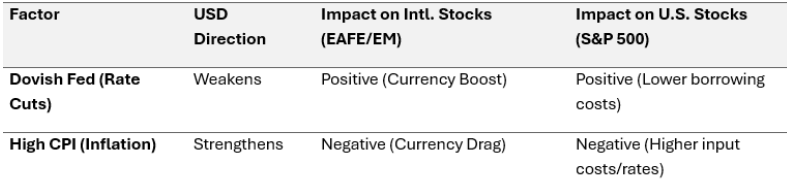
While inflation spikes could slow the Fed’s rate-cut path later in 2026, the current policy lean and softening dollar backdrop remain supportive for non-U.S. markets.
ETFs to Watch
Here are three global ETFs worth considering for diversified exposure across developed and emerging markets:
🌍 1. Vanguard FTSE All-World ex-US ETF (VEU)
Tracks the FTSE All-World ex-US Index
~3,500+ holdings
Covers both developed and emerging markets
Low expense ratio
Best for: Broad, low-cost global diversification in one fund.
🌱 2. Avantis Emerging Markets Equity ETF (AVEM) - Focusing on Emerging markets with a tilt toward:
Lower price-to-book stocks
Higher profitability companies
Systematic approach to factor tilting
Lower turnover relative to many EM funds
Why it’s interesting: They strategically overweight more profitable names and those trading at lower price/book ratios by scaling each stock's market-cap weight by a multiplier.
3. iShares MSCI Brazil ETF (EWZ) - Most liquid ETF for Brazil exposure
With Heavy exposure to: Financials, Energy and Materials
Benefiting from: Commodity strength, Dollar weakness and Capital rotation into EM
Best for: Investors seeking targeted exposure to a high-beta emerging market with strong earnings momentum.
1-Year Performance Comparison
Below is a 1-year return comparison of: VEU, AVEM, EWZ and IVV (S&P 500 ETF)
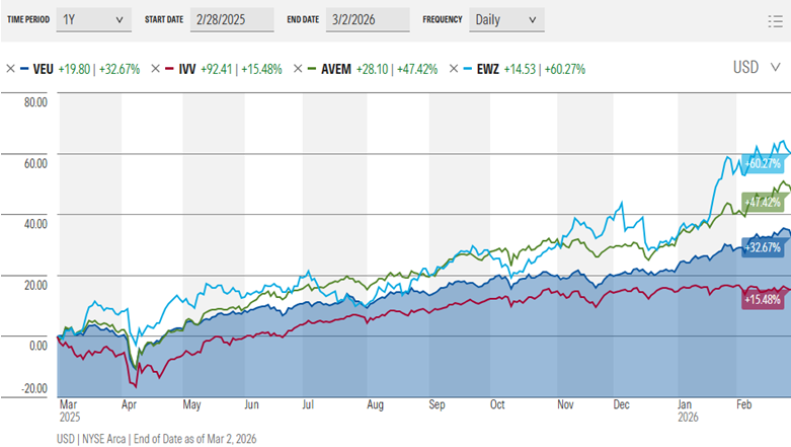
As the chart shows:
EWZ led the group (+60%+)
AVEM significantly outperformed IVV
VEU delivered solid returns
IVV lagged the emerging-market exposure over this period
How to Think About It
VEU → Broad global core
AVEM → Valuation + quality tilt in EM
EWZ → Tactical, higher-risk emerging market exposure
International investing isn’t about abandoning the U.S. It’s about reducing concentration risk and expanding your opportunity set.
Bottom Line
Global markets may not dominate headlines the way the Magnificent 7 do. But they offer:
Lower valuations
Higher dividend yields
Improving earnings momentum
Potential currency tailwinds
True diversification away from U.S. mega-cap concentration
By expanding your horizons, you may just expand your returns.
Please note - This isn’t a recommendation to buy or sell…it’s simply a framework to think through global diversification and stress-test whether adding international exposure makes sense for your own portfolio and time horizon.
Happy Reading,
and as always Invest Smart.
Pooja 😊
