Byte # 24: Build Wealth the Simple Way — 4 ETFs That Do the Heavy Lifting
Happy Monday Dear Friends,
Today’s Byte is for anyone interested in long-term buy-and-hold investing, dollar-cost averaging, and keeping their portfolio simple and easy to manage.
Let me start with a brief introduction to ETFs — an ETF is a basket of investments that trades on a stock exchange just like a single stock. They are powerful tools for broad market exposure. Here are some key benefits of owning an ETF:
Diversification: ETFs provide a way to invest in a diversified group of securities, often tracking a specific index (like the S&P 500), sector (like technology), or investment strategy.
Trading Flexibility: Unlike mutual funds, which are priced once a day after the market closes, ETF share prices fluctuate throughout the trading day, allowing for buying and selling at current market prices.
Cost-Efficiency: Many ETFs, particularly those that are passively managed and track an index, are known for their low expense ratios and can be more cost-effective than actively managed mutual funds.
Liquidity: ETFs are generally considered liquid assets, meaning they can be easily bought and sold on an exchange.
Tax Efficiency: ETFs are often considered a more tax-efficient investment vehicle compared to mutual funds.
Examples of ETFs
Index ETFs: Track a specific market index, like the Vanguard Total Stock Market ETF (VTI) or iShares Core S&P 500 ETF (IVV).
Sector ETFs: Focus on specific industries or sectors, such as technology or healthcare.
Bond ETFs: Invest in various debt securities.
Commodity ETFs: Track the performance of commodities like gold or oil.
Actively Managed ETFs: Have portfolio managers making decisions about which securities to include, aiming to outperform the market.
My Top 4 ETF Picks
In my opinion, everyone should have the following four ETFs in their portfolio. The first three form your core portfolio, while the fourth can serve as a satellite holding to enhance your overall returns
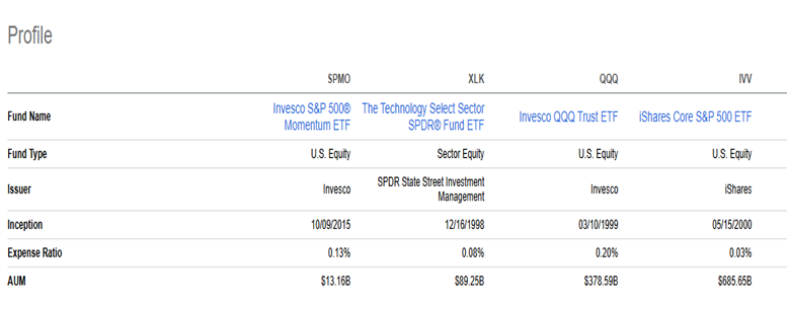
IVV: The iShares Core S&P 500 ETF tracks the S&P 500 Index. Alternatively, investors can consider SPY (SPDR S&P 500 ETF Trust), which tracks the same index.
QQQ: The Invesco QQQ Trust tracks the Nasdaq-100 Index, composed of the 100 largest non-financial companies listed on the Nasdaq Stock Market and weights them by market capitalization, with provisions to mitigate concentration. It has portfolio construction flaws: it only includes stocks traded on Nasdaq and excludes key growth stocks listed on the NYSE (e.g., Oracle, Eli Lilly).
XLK: The Technology Select Sector SPDR Fund invests in the technology sector of the S&P 500 Index. It is composed of 69 stocks with more concentrated pure technology sector exposure.
SPMO: The Invesco S&P 500 Momentum ETF tracks the S&P 500 Momentum Index, which selects the 100 S&P 500 stocks with the strongest 12-month price momentum, adjusted for volatility, and rebalances twice a year. It is generally viewed as a short- to medium-term tactical holding, rather than a pure long-term buy-and-hold ETF.
Here’s a brief summary of each of them:
Staying the Course with Dollar-Cost Averaging
It’s important to remember that “time in the market beats timing the market.” Consistency is key. Through Dollar-Cost Averaging (DCA), you invest a fixed amount (say, $500 per month) in these ETFs regardless of market conditions. This strategy helps smooth out volatility and takes advantage of long-term market growth — and history shows that the strongest recoveries often follow the deepest bear markets.
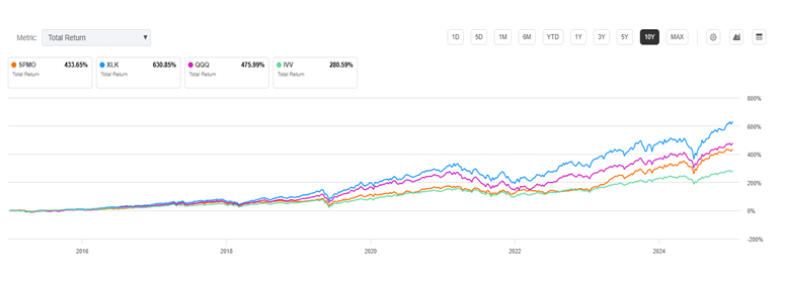
10-Year Performance Snapshot
XLK: +631%
QQQ: +476%
SPMO: +434%
IVV: +281%
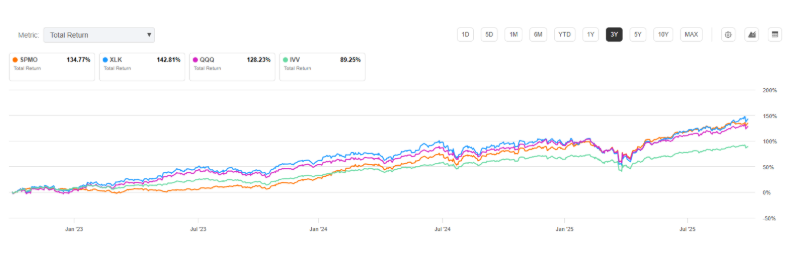
Notably, over the past three years, SPMO has outperformed both IVV and QQQ due to its momentum-driven strategy, which thrives in bull markets when winning stocks continue to rise. However, it may lag during market shifts or downturns, as momentum stocks often see sharper corrections.
There are certainly many other excellent ETFs to consider, but I chose these four because they’ve consistently delivered strong returns over the past 10 years — outperforming broader options like VTI (Vanguard Total Stock Market ETF) or VEA (Vanguard FTSE Developed Markets Index Fund) for international exposure. Nonetheless, you could still add these or others to the portfolio for diversification.
That’s it, my friends! I hope you found this useful. Feel free to reach out with any questions or comments — I’d love to hear from you.
Have a great day!
Your friend in investing,
Pooja
