Byte # 18: The Rise of Covered Call ETFs – A Way to Generate Passive Income (But understand the trade offs)
Today I bring you Byte #18 on Covered Call ETFs, which have seen a significant surge in popularity. Since 2022, there’s been a major boom in these funds, driven by investors chasing higher yields in a low-rate environment. In fact, according to Morningstar, over $100 billion has flowed into covered call ETFs in just the last three years.
So, what exactly is a Covered Call ETF?
A covered call ETF is an actively managed exchange-traded fund that seeks to capture the benefits of writing call options on stocks—without requiring investors to directly participate in the options market. For those who want simplicity, this provides a way to generate income while avoiding the complexities of managing options on their own. Broadly, covered call ETFs combine two main features:
Reduced volatility potential
Increased income generation
How Covered Call ETFs Work
Imagine an ETF that owns an asset (or index), such as the S&P 500 or the NASDAQ 100, and then writes a call option on that underlying asset. This is known as a buy-write strategy, where the ETF effectively grants a buyer the option:
To purchase the asset at a specific price
Within a specific time frame
For an upfront premium payment
By selling the call option, the ETF is able to:
Collect the premium immediately for giving the buyer the right to purchase at a fixed strike price.
Potentially miss out on gains if the underlying asset rises above that strike price, as the ETF is obligated to sell at the lower fixed price.
Earn consistent premium income, though at the cost of capping maximum profits—similar to collecting insurance premiums but being liable for claims if certain events occur.
Example
Let’s say an ETF owns Stock X at $100 and writes a call option allowing someone to buy it for $105 in 30 days, in exchange for a $10 premium:
If the stock stays below $105 after 30 days, the ETF keeps both the stock and the $10 premium.
If the stock rises above $105, the ETF must sell at $105 (instead of the higher market price), but still retains the $10 premium.
The maximum profit = ($105 – $100) + $10 = $15, realized if the stock is at or above $105 at expiry.
This shows why covered call ETFs generate steady income but sacrifice some upside potential in strong markets.
Benefits and Risks of Covered Call ETFs
Benefits
Typical yields range between 8% and 14% in 2025, though some specialized or leveraged ETFs advertise even higher (and sometimes unsustainably high) payouts.
Many distribute monthly income, though schedules vary. Income is tied to option premiums, which depend on market conditions and the fund’s strategy.
Actively managed—though this generally means higher expense ratios.
Tax Considerations
Index Options and Section 1256 Contracts: Many funds use index options, which get favorable IRS treatment—60% long-term and 40% short-term gains regardless of holding period, reducing effective tax rates compared to ordinary income.
Premium Income Taxation: The premiums earned from selling call options are generally taxed when the options expire or are closed. For qualified covered calls, this income is treated as capital gains rather than ordinary income, benefiting investors in taxable accounts.
Return of Capital and Tax Deferred Gains: Some distributions may be classified as return of capital (ROC), which is not immediately taxable but reduces the investor’s cost basis in the ETF. This defers tax liability until the investor sells ETF shares, creating a tax deferral benefit that can enhance after-tax returns over time.
Risks
While writing covered calls may help buffer some downside, these ETFs do not eliminate loss risk, particularly during sharp drawdowns or rallies that force shares to be called away.
The premiums fluctuate - they are not static. For example, trailing 12-month yield on JP Morgan Equity Income ETF (JEPI) has landed somewhere between 6.5% and 12% over the last five years.
Premiums are tied to the volatility of the asset – as the assets get more volatile, the premiums tend to go up but as it gets more stable, the premiums tend to go down.
Price Return vs Total Return
It’s important to distinguish between the two:
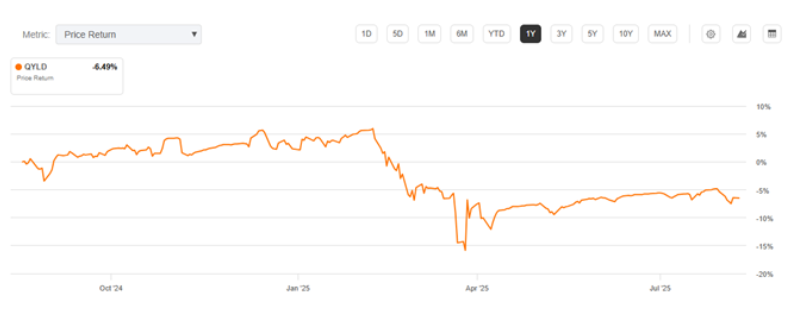
Price Return = the change in market price of ETF shares, excluding option premiums or dividends. Example: QYLD (Global X NASDAQ 100 Covered Call ETF) had a NAV of $17.93 on Oct 1, 2024, compared to $16.63 today—a price return of -6.49% over the past year.
Total Return = price return + option premiums + dividends. For the same QYLD, the total return was +6.27% over the past year.
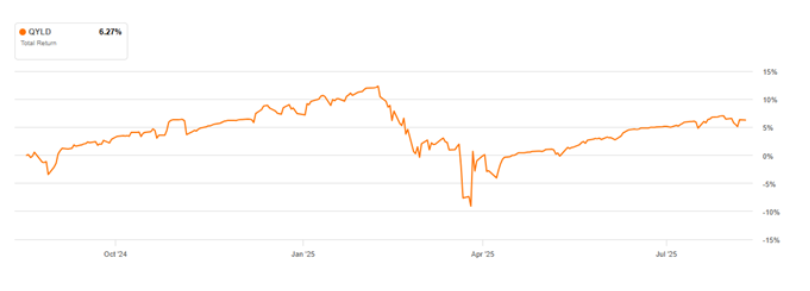
This shows why total return is the right metric for evaluating these funds.
Who Should Consider These ETFs?
Morningstar’s Daniel Sotiroff puts it well:
“If I’m young, and I’ve got the risk tolerance, you’re better off being in a low-cost S&P 500 ETF where most of your gains will be price appreciation. These funds are not great long-term investments if you’re in the accumulation phase of your financial plan.”
That said, if you are looking to earn extra yield on cash, covered call ETFs could be an option—just understand the risks.
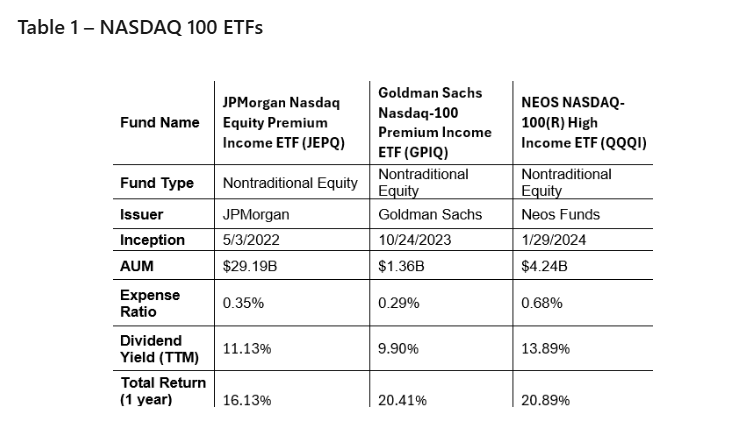
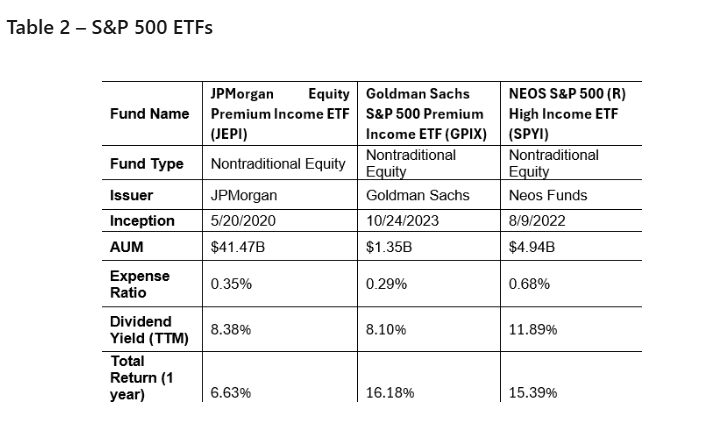
Covered Call ETF Comparison for 3 popular funds
Additional resources:
· GPIQ
Final Take
In short, covered call ETFs are income-focused funds that generate yield by holding stocks and selling call options on them. They typically provide yields between 7% and 13%, offering steady income with potentially lower volatility. However, they also cap upside during rallies and involve tax complexities (favorable treatment of premiums, deferred liabilities from ROC distributions).
Each fund has its own strategy for how it writes the calls, so it’s important to understand the methodology before investing, as differences in strike selection, option duration, and asset coverage can significantly impact returns.
These funds may appeal to income-seeking investors prioritizing cash flow over growth. Just remember the trade-offs: capped gains, fluctuating yields, and tax considerations.
As always, my goal is to bring you diverse investment ideas and break them down simply to support your decision-making. I hope you found this helpful—feel free to share questions or comments.
See you on September 8th (I’ll be taking a short break for Labor Day weekend).
Cheers,
Pooja
